How an advisor is paid shapes the conflicts they bring to your table. Rules since 2016 have narrowed the gap between brokers and fiduciary advisers, but haven’t closed it. Here is how compensation and legal standards line up today.
Titles still tell you little
“Financial advisor” and “financial planner” are still largely unregulated labels. Regulators look at what a firm does, not what it calls itself. There is one exception. Under Regulation Best Interest, a broker-dealer that is not also registered as an investment adviser generally can’t use “adviser” or “advisor” in its name or its reps’ titles. Dual registrants and insurance agents can still use the word. So a title alone won’t tell you which standard applies.
The three main types of advisors
Most people giving financial advice fall into one of three groups: registered investment advisers (RIAs), broker-dealer representatives (stockbrokers), and insurance agents. Many people hold more than one license. They can wear different hats from one recommendation to the next.
The standards they are held to
Investment advisers: fiduciary. RIAs owe clients a fiduciary duty under the Investment Advisers Act of 1940. In 2019 the SEC set out what that duty means. It has two parts: a duty of care (advice in the client’s best interest, based on a reasonable understanding of their goals) and a duty of loyalty (no placing the adviser’s interests first, and full and fair disclosure of conflicts). It covers the whole advisory relationship, not just individual trades.
Brokers: Regulation Best Interest. Since June 30, 2020, the SEC’s Regulation Best Interest (Reg BI) has required brokers to act in a retail customer’s best interest when they make a recommendation. They also may not put their own financial interest ahead of the customer’s. Reg BI has four parts: disclosure, care, conflict of interest, and compliance. Firms must spot conflicts and disclose them. They must reduce the ones that push reps to favor certain products, and ban sales contests and quotas tied to specific products within limited periods.
Why Reg BI is still not a fiduciary standard. Reg BI raised the bar, but it is not the adviser fiduciary duty. It applies at the moment a broker makes a recommendation. Brokers have no ongoing duty to monitor an account unless they agree to one. They can still earn commissions and sell proprietary products, as long as they disclose and manage those conflicts. The SEC made it a best-interest standard but chose not to call it fiduciary.
Insurance agents. Insurance is regulated by the states, not the SEC. In 2020 the NAIC updated its model annuity sales rule to require a “best interest” standard. Most states have since adopted it. Like Reg BI, it requires agents to act in the consumer’s best interest and disclose how they’re paid. It stops short of a fiduciary duty. For non-annuity products such as most life insurance, suitability or lighter standards often still apply.
How advisors are paid
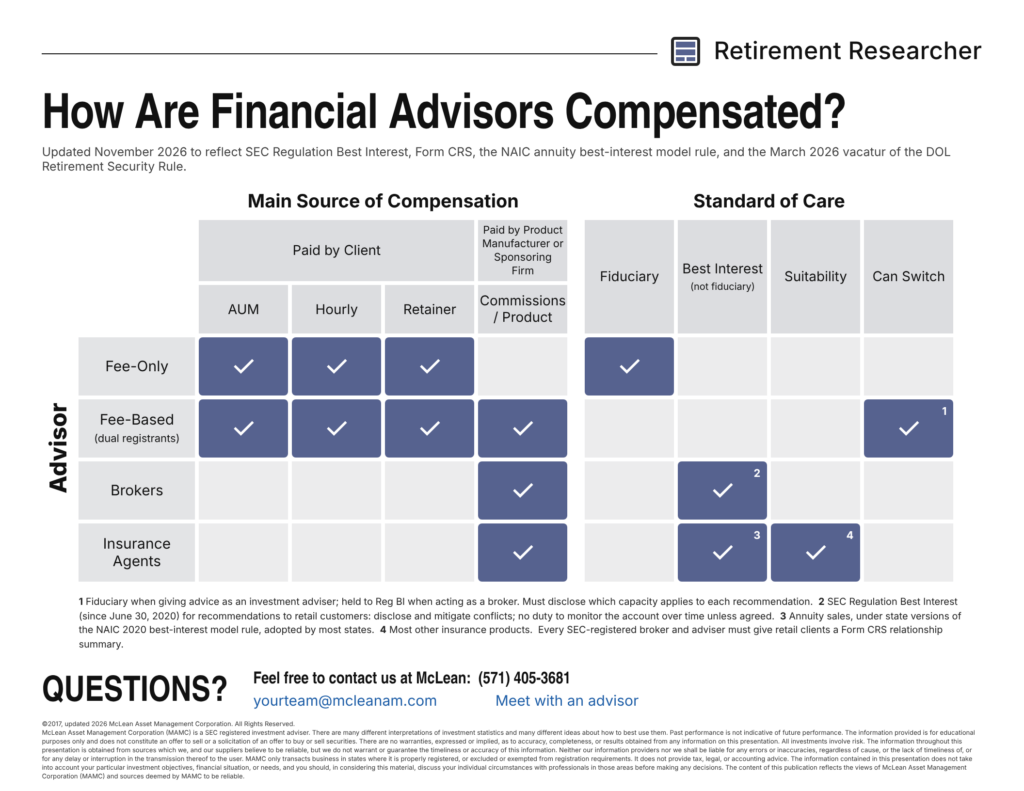
Fee-only. Fee-only advisers are paid only by their clients. That might be a percentage of assets managed, an hourly rate, a flat fee, or a retainer. They take no commissions on products. That removes the biggest product-sales conflicts, though no pay model is free of conflicts. An asset-based fee, for example, rewards gathering more assets.
Fee-based (dual registrants). Dual registrants are licensed as both investment adviser reps and brokers. They can charge advisory fees on some accounts and earn commissions on others. They are fiduciaries only for the advisory part of the relationship. Such advisors should say “fee-based,” not “fee-only.” Reg BI also requires a dually registered rep to tell you which capacity they are acting in when they make a recommendation.
Commission-based. Brokers and insurance agents paid by commission are paid by product providers or their firm. Higher-paying products create an incentive. Reg BI and the NAIC model rule require these conflicts to be disclosed and mitigated, not just tolerated. The incentive is smaller but still there.
Think of a salesperson at a single car dealership. They’ll show you that dealer’s cars, not the best car on the market. Today’s rules require them to pick the car on the lot that best fits you, and to tell you how they’re paid. They still won’t send you to the competitor across the street.
At a glance
Fee-only advisers are fiduciaries. Fee-based dual registrants switch between fiduciary and Reg BI depending on the account. Brokers are held to a best-interest standard. Insurance agents follow best interest on annuities and suitability on most other products. The chart below shows how each type of advisor is paid and the standard that applies.
Form CRS: the one document to ask for
Since June 30, 2020, every SEC-registered broker-dealer and investment adviser serving retail investors must give you a Form CRS (Customer Relationship Summary). It is a short, plain-English summary of up to four pages. It covers the services offered, fees and costs, conflicts of interest, the standard of conduct that applies, and any disciplinary history. You can also look up any advisor’s registrations and record on the SEC’s Investment Adviser Public Disclosure site or FINRA BrokerCheck.
Retirement accounts and the Department of Labor
The DOL’s 2016 fiduciary rule for retirement accounts never took full effect. The Fifth Circuit Court of Appeals vacated it in 2018. The DOL tried again with its 2024 “Retirement Security Rule.” It would have treated many one-time recommendations, including IRA rollovers and annuity sales, as fiduciary advice. Federal courts in Texas stayed it in 2024, before it took effect. The DOL stopped defending it in 2025, and the courts vacated it in March 2026. The DOL updated the federal regulations on March 20, 2026, and has said it has no plans for a new rule.
The DOL’s original 1975 five-part test now governs again. Under it, advice is fiduciary under ERISA only if it is given regularly, under a mutual understanding, as a primary basis for decisions, and individualized to the plan or IRA. A single rollover recommendation often won’t meet that test. For a broker or agent, Reg BI and the state annuity rules usually apply to that recommendation instead. Advisers who are fiduciaries under the five-part test can still rely on the DOL’s PTE 2020-02 exemption for compensation they earn, such as on rollovers.
Bottom line
The gap between brokers and advisers is narrower than it was in 2016, but it hasn’t closed. Ask every advisor three things in writing:
- Are you a fiduciary at all times, for all my accounts?
- How exactly are you paid?
- Can I see your Form CRS?
Sources
- U.S. Securities and Exchange Commission, Regulation Best Interest: The Broker-Dealer Standard of Conduct, Release No. 34-86031 (June 5, 2019; compliance date June 30, 2020)
- U.S. Securities and Exchange Commission, Form CRS Relationship Summary, Release No. 34-86032 (June 5, 2019)
- U.S. Securities and Exchange Commission, Commission Interpretation Regarding Standard of Conduct for Investment Advisers, Release No. IA-5248 (June 5, 2019)
- NAIC, Suitability in Annuity Transactions Model Regulation (#275), revised 2020
- Chamber of Commerce v. U.S. Department of Labor, 885 F.3d 360 (5th Cir. 2018), vacating the 2016 DOL fiduciary rule