One of the most familiar concepts in retirement planning is the safe withdrawal rate, which is the percentage of an investment portfolio you can withdraw each year without running out of money. For many retirees, that conversation begins and ends with a single number: 4%.
The so-called 4% rule originated in research examining historical U.S. stock and bond returns and posed a simple question: how much could a retiree withdraw annually without depleting a portfolio over a long retirement? The conclusion was that withdrawing 4% in the first year of retirement, then increasing that dollar amount annually with inflation, survived even the most difficult historical periods over a 30-year retirement.
To put that into concrete terms, a retiree with a $1,000,000 portfolio would withdraw $40,000 in the first year. If inflation were 3% the following year, the withdrawal would rise to $41,200, regardless of whether markets were up or down. The rule assumes this inflation adjustment continues mechanically, even though many retirees adjust spending in practice.
The elegance of this framework accounts for its enduring appeal. It gives retirees a sense of structure and discipline. However, retirement rarely unfolds exactly as a historical back-test would predict. Once you look more closely, the 4% rule turns out to be highly sensitive to assumptions that deserve more scrutiny than the rule itself usually receives.
The Assumptions Doing the Heavy Lifting
The original research was thoughtful and careful, but it depended on conditions that don’t always line up neatly with real life.
The data used in the research were from historical U.S. stock and bond returns, a period generally favorable for U.S. investors relative to many other markets and historical experiences. While this history includes wars, recessions, and market crashes, it also benefited from strong economic growth, favorable demographics, and rising productivity. There is no guarantee that future returns will be the same, particularly when retirement begins during less favorable market environments.
Inflation plays an especially important role. Withdrawals under the 4% rule are adjusted annually to maintain purchasing power. That approach works reasonably well when inflation is low and stable. When inflation is elevated early in retirement, spending rises just as portfolios may be under pressure, creating a particularly challenging dynamic.
Taxes are another quiet assumption. Most safe withdrawal rate research is presented on a pre-tax basis. Retirees, however, spend after-tax dollars. Withdrawals from traditional retirement accounts must also account for tax liabilities, and taxable accounts incur ongoing tax drag from interest, dividends, and realized gains. A “4% withdrawal” from an IRA is not the same thing as 4% of spendable income.
Portfolio construction matters as well. The classic framework assumes a broadly diversified, low-cost portfolio that is rebalanced consistently and managed with discipline. Real-world portfolios often differ in terms of concentrated holdings, higher costs, income-focused strategies, or illiquid assets, all of which can affect the sustainability of a given withdrawal rate.
Finally, the 4% rule was designed around a 30-year retirement horizon. Retire earlier, or simply live longer than expected, and the margin for error shrinks. Longevity stretches every assumption, even when markets cooperate.
Why a Portfolio-Only Strategy Can Feel Uncomfortable
When retirement income depends entirely on an investment portfolio, risk becomes personal in a way that spreadsheets do not fully capture. Market downturns early in retirement can permanently reduce sustainable spending due to sequence-of-returns risk, even if long-term averages eventually appear reasonable. Inflation adds further strain by forcing withdrawals higher during periods when portfolios may already be stressed. Longevity risk compounds these challenges, as living longer than expected requires assets to stretch further with less room for error. Together, these forces can create a persistent sense of uncertainty in which retirees feel compelled to monitor markets closely, rerun projections, and second-guess spending decisions. Even when the math suggests a plan is viable, relying solely on investments can feel fragile because there is no guaranteed income floor to absorb shocks when conditions move in the wrong direction.
Recent history has reinforced this discomfort. Periods when both stocks and bonds decline at the same time, combined with elevated inflation, are especially challenging for retirees following a rigid, inflation-adjusted spending rule. Withdrawals rise as portfolio values are pressured, highlighting how sensitive portfolio-only strategies are to unfavorable timing.
When 4% May Be Too Conservative
Importantly, these risks do not mean the 4% rule is always too aggressive. At times, it can be overly cautious in the right circumstances.
Retirees who begin during periods of moderate inflation and reasonable interest rates may find their portfolios support higher spending. Flexibility matters as well. Those willing to adjust spending during market downturns often have more room than a rigid rule implies. Time horizon also plays a role; an 85-year-old retiree does not face the same risks as someone retiring at 60.
Other conditions that can support spending above 4% include lower tax drag, a portfolio structured for growth rather than income generation, and the support of reliable income sources that reduce reliance on portfolio withdrawals. Two retirees can follow the same 4% rule and experience very different outcomes depending on when they retire and how markets behave early on. In favorable environments, sustainable withdrawals may exceed 4%. The challenge is that retirees only learn which environment they were in after the fact.
The Real Lesson: Spending Depends on Forces You Don’t Control
The deeper lesson behind the safe withdrawal rate debate is that retirement spending from a portfolio is never fully within your control. Market returns, inflation, tax policy, and longevity all influence the sustainability of withdrawals, often in ways that cannot be predicted at the outset of retirement. A diversified portfolio can support income over time, but it does not create certainty. Instead, it requires ongoing judgment about how much to spend, when to adjust, and how to respond as conditions evolve. The withdrawal rate is not a fixed answer so much as a moving target, shaped by external realities that change throughout retirement. This is why retirees who rely primarily on investments often feel pressure to revisit assumptions when their plan appears sound on paper.
How Reliable Income Changes the Conversation
This is where dependable income sources can make a meaningful difference. A guaranteed income stream, such as Social Security, covers a portion of spending regardless of market conditions, inflation risks, or portfolio volatility.
When core expenses are already funded, the investment portfolio no longer carries the full emotional burden of retirement. Withdrawal decisions become more about lifestyle choices and less about survival. That change alone can reduce anxiety and make portfolio-based spending feel more manageable, even if total wealth remains the same.
A More Practical Way to Think About Withdrawal Rates
Rather than asking, “Is 4% safe?”, a more useful question is:
Given today’s markets, my tax situation, my spending flexibility, and my other income sources, how much can I reasonably spend, and how often should I revisit that decision?
Seen in this way, the 4% rule remains valuable. It provides context and discipline. But it works best as a reference point, not a promise. Withdrawal decisions evolve as conditions change, and portfolio based spending requires ongoing judgment rather than a single fixed number.
For many retirees, spending from a portfolio is where these ideas move from theory to lived experience. Conditions rarely stay constant, and withdrawal decisions often need to adjust as circumstances change. If it helps to see how different spending approaches respond as the road unfolds, the Spending from an Investment Portfolio in Retirement Workshop walks through practical ways retirees manage withdrawals over time.
A safe withdrawal rate is less like a posted speed limit and more like driving in changing weather: you set an initial pace, watch conditions closely, and adjust as the road unfolds. For most retirees, confidence comes not from finding the perfect number, but from building a plan that can adapt when conditions change.
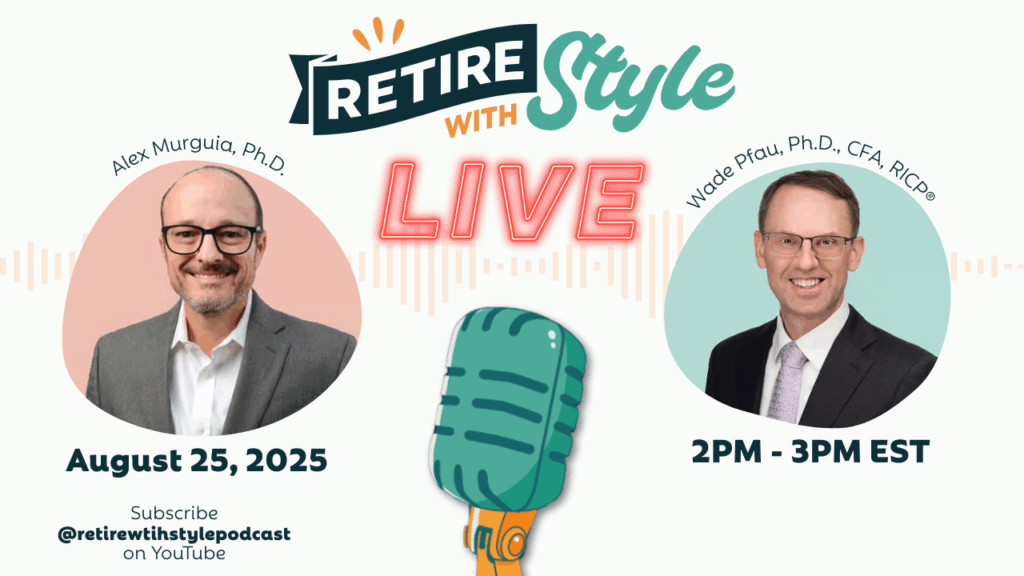
Want to learn more? Listen to Episode 214 of the Retire With Style Podcast.